Few political symbols have crossed the boundary from ideology to aesthetics as completely as the hammer and sickle. Designed in 1917 to represent the unity of industrial workers and peasant farmers, the crossed tools became the defining emblem of the Soviet Union — and eventually one of the most reproduced images in fashion, streetwear, and counterculture worldwide.
But how did a symbol created for political propaganda end up on runway collections, punk jackets, and bestselling t-shirts? The answer lies in the extraordinary visual power of Soviet design, the paradoxes of consumer capitalism, and the enduring human attraction to symbols of rebellion.
Origins: A Symbol Forged in Revolution
The hammer and sickle first appeared during the Russian Revolution of 1917. The hammer represented industrial laborers, the sickle represented agricultural workers, and together they symbolized the alliance between the two classes that formed the backbone of Bolshevik ideology. The symbol was formally adopted as part of the Soviet flag in 1923 and quickly became the most visible emblem of communism worldwide.
What made the symbol so effective wasn't just its political meaning — it was its design. The hammer and sickle is geometrically elegant, instantly recognizable at any scale, and visually balanced. Soviet graphic designers understood something that fashion designers would later rediscover: great symbols work because of their form, not just their content.
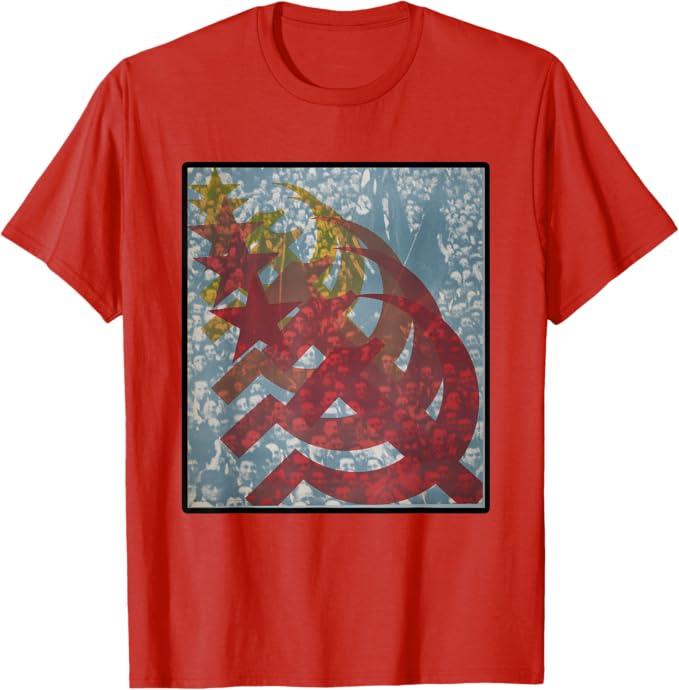
Hammer & Sickle Star — Mass Rally Art Tee
Cold War Cool: Counterculture Adoption
The hammer and sickle's journey into Western fashion began in the 1960s and 1970s, when countercultural movements adopted communist imagery as a deliberate provocation. Wearing a Soviet symbol in Cold War America or Western Europe was an act of defiance — a way to signal opposition to the establishment, capitalism, and conformity.
Punk rock accelerated this trend in the late 1970s. Bands and fans wore Soviet military surplus, red star pins, and hammer and sickle patches alongside swastikas, anarchy symbols, and other provocative imagery. The goal wasn't ideological endorsement — it was shock value and the subversion of sacred symbols. The hammer and sickle was perfect for this purpose precisely because it carried so much cultural weight.
The Propaganda Poster Aesthetic
Soviet propaganda posters are now widely recognized as masterworks of graphic design. The bold colors, dramatic compositions, heroic figures, and striking typography that defined Soviet visual culture from the 1920s through the 1960s have influenced generations of designers, illustrators, and artists.
Design schools worldwide study Soviet constructivism — the art movement that produced many of the most iconic propaganda images. Artists like Alexander Rodchenko, El Lissitzky, and Gustav Klutsis created works that were simultaneously political tools and genuine artistic achievements. Their influence can be seen in everything from Shepard Fairey's "Obey" campaign to contemporary streetwear graphics.
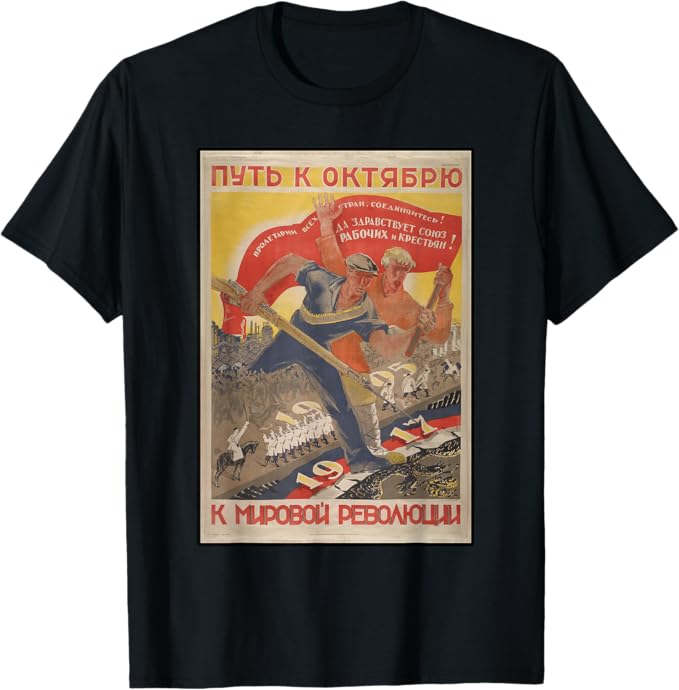
1917 Russian Revolution — Path to October Tee
High Fashion Meets the Proletariat
By the 1990s and 2000s, communist imagery had fully crossed into mainstream fashion. Luxury brands and high-street retailers alike incorporated hammer and sickle motifs, red star imagery, and Soviet-style typography into their collections. The irony of capitalist fashion houses selling communist symbols at premium prices was not lost on critics — but it didn't slow the trend.
The appeal was straightforward: Soviet design is visually striking, culturally loaded, and instantly recognizable. A hammer and sickle on a t-shirt communicates something — whether that's political conviction, historical awareness, ironic detachment, or pure aesthetic appreciation depends entirely on the wearer.
Why It Still Works Today
The hammer and sickle endures in fashion for the same reasons it worked as propaganda: it's a brilliantly designed symbol that carries enormous cultural weight. Whether worn as a political statement, a historical reference, an ironic commentary on capitalism, or simply because the design looks incredible on a black t-shirt, the symbol continues to resonate.
Today's communist-themed fashion exists in a space where history, art, politics, and personal expression intersect. The best designs — the ones that sell consistently and start conversations — are those that treat the source material with visual respect while leaving room for the wearer to bring their own meaning.
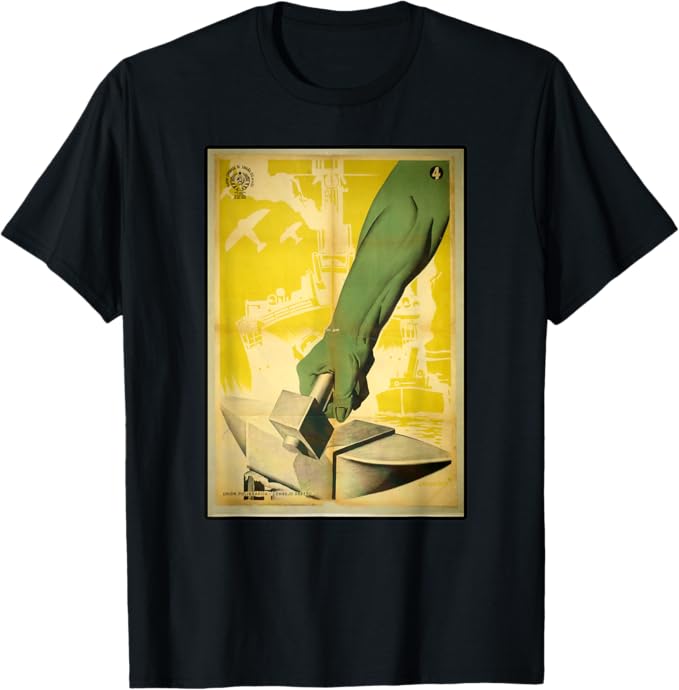
Communist Hammer — Arm & Anvil Industry Tee
Browse the Full Collection
★ Shop All ShirtsAs an Amazon Associate, CommunistShirts.com earns from qualifying purchases. Prices are accurate at the time of publication.